5 Signs of Hidden Water Damage in Your Riverton Home
Most water damage in Riverton homes doesn’t announce itself with a flood. Instead, it builds quietly behind walls, under floors, and inside insulation — often for weeks or months before any visible sign appears. By the time you notice a stain on the ceiling or a musty smell in the basement, the water damage may already be extensive. Knowing the 5 signs of hidden water damage in Riverton homes can help you catch problems before they compound into mold infestations or structural failures.
In this post, we cover what each warning sign looks like, what’s likely causing it, and what you should do next — including when professional water damage restoration in Riverton is the right call.
Suspect Hidden Water Damage in Your Riverton Home?
Our moisture detection team uses thermal imaging to find what you can't see. Call (877) 698-1311 for a free assessment.
Why Hidden Water Damage Is Especially Common in Riverton
Riverton’s unique risk factors make hidden water damage more common here than in many other Utah communities. The clay-heavy Lake Bonneville soils that surround foundations hold moisture against basement walls for extended periods following rain or snowmelt — a chronic low-level moisture exposure that doesn’t create obvious flooding but gradually saturates wall assemblies. The Utah & Salt Lake Canal’s lateral seepage can raise groundwater tables in Monarch Meadows and surrounding neighborhoods independently of weather events. And Utah’s dry ambient air can cause wall surfaces to dry out quickly even while insulation and framing behind them remain saturated — a false sense of security that allows damage to continue undetected.
Understanding these local conditions is the backdrop for recognizing the five warning signs that matter most for Riverton homeowners.
Sign 1: Unexplained Musty Odor in the Basement
A persistent musty smell in your Riverton basement is one of the most reliable early indicators of hidden water damage and the mold growth that follows it. Musty odors from mold are often detectable before any visible growth appears — mold colonies can produce odor-causing volatile organic compounds (VOCs) while they are still microscopic and hidden inside wall cavities, behind baseboards, or under flooring.
The fact that a smell is localized to the basement rather than the whole house is significant: it points toward a moisture source at or below grade level rather than a plumbing leak in an upper floor. In Riverton homes, this most commonly indicates chronic groundwater moisture contact with below-grade foundation walls or floor assemblies — a pattern associated with the clay soil hydrostatic pressure that characterizes Salt Lake County’s spring and early summer months.
Don’t try to mask a musty basement odor with air fresheners — that approach temporarily covers the symptom while the underlying moisture condition continues. A professional mold remediation assessment that includes moisture meter readings and air sampling is the only way to confirm whether mold is present and where it is located.
Sign 2: Staining or Bubbling on Walls and Ceilings
Water stains — yellowish-brown discoloration on drywall or ceiling tiles — are among the most visible signs of hidden water damage, but their location can be misleading. A stain on a second-floor ceiling may indicate a roof leak, an upper bathroom’s plumbing, or an HVAC condensate line. A stain on a first-floor ceiling near an exterior wall may indicate a wall flashing failure. The stain shows where water has accumulated, not necessarily where it entered.
Bubbling or peeling paint is a closely related sign: paint that bubbles, blisters, or peels away from a surface is typically caused by moisture vapor pushing through from behind. In Riverton homes with below-grade walls, this sign often appears in basements and lower levels after periods of elevated groundwater or spring snowmelt — the water is moving through the concrete or block foundation wall by capillary action and accumulating behind the paint or drywall layer.
Both signs indicate that water mitigation has been needed for some time. If the stain is old and dry, the water event may have passed — but structural damage and mold can persist. If the stain is still wet or actively growing, professional water damage restoration is needed immediately to prevent further penetration.
Sign 3: Warped or Buckled Flooring
Wood and laminate flooring that begins to warp, cup, buckle, or develop visible gaps between planks is responding to moisture — either rising from below or penetrating from the surface. In Riverton’s climate, warped flooring in a basement or on a first floor near an exterior wall is a strong indicator of hidden water intrusion from below-grade sources.
Concrete subfloors that appear fine visually can hold significant moisture: concrete is porous and absorbs water slowly but continuously when in contact with saturated soil. When moisture rises through a concrete slab and reaches wood flooring above, the wood absorbs the moisture and expands unevenly — causing warping, cupping, and eventually delamination. This pattern is common in Riverton homes where basements were finished without a vapor barrier between the concrete slab and the flooring material above it.
Tile floors over concrete can also indicate hidden water damage: cracked or loose tiles, grout that crumbles, and hollow-sounding sections all suggest that moisture has compromised the adhesive layer beneath. The floor may look mostly intact while the moisture-damaged underlayment below drives ongoing structural drying needs.
Warped Floors or Wall Stains in Your Riverton Home?
Thermal imaging finds hidden moisture in walls and subfloors before it becomes a major repair. Call Riverton Water Damage Restoration at (877) 698-1311.
Sign 4: Spike in Unexplained Water Bills
A water bill that has increased without any change in household usage habits is a strong signal that you have an active water leak somewhere in your plumbing system. The most dangerous hidden leaks are slow leaks inside walls — a pinhole in a copper pipe or a failing fitting in a supply line that drips continuously into wall insulation. These leaks can run for months without producing any visible surface indicator, all while saturating insulation and framing and establishing conditions for mold.
In Riverton homes, this type of hidden leak often occurs in older copper or galvanized steel plumbing systems. Neighborhoods like Saddlebrook Estates and Rose Creek contain homes built in the 1980s and 1990s with original plumbing that may be showing its age — small fitting failures and pinhole corrosion become more common as these systems approach 30–40 years of service.
To isolate the source of an unexplained water bill increase, turn off all water fixtures and check whether your water meter continues to move. If it does, there is an active leak in your plumbing system — call a plumber to locate and repair the leak, and call a water damage restoration professional to assess the damage the hidden leak has caused in the surrounding materials.
Sign 5: Doors and Windows That Stick or Won’t Close Properly
Wood frames expand when they absorb moisture. Doors and windows that have recently begun sticking, binding, or refusing to close properly — without any obvious cause like a house settling or seasonal humidity change — can indicate that the surrounding framing has absorbed moisture from a hidden water source.
This sign is particularly relevant in Riverton basements and lower levels, where door frames in below-grade spaces are the first structural wood elements to contact moisture from soil and foundation sources. A door at the base of a stairwell that was previously easy to open and close and has gradually become sticky is telling you that the wood framing in that area has been absorbing moisture consistently over time.
This sign tends to appear later in a hidden water damage scenario than the other indicators — by the time framing has absorbed enough moisture to cause dimensional changes, the water exposure has typically been ongoing for weeks or months. If you notice sticking doors alongside a musty odor or discolored walls, treat the combination as a high-priority signal for professional moisture assessment.
What to Do When You Notice These Signs
Discovery of any of these signs in your Riverton home warrants action, not monitoring:
- Document immediately — photograph the area and note when you first noticed the sign, as this information is important for insurance claims.
- Don’t dry it yourself — running a household fan or dehumidifier delays professional assessment without addressing the hidden damage.
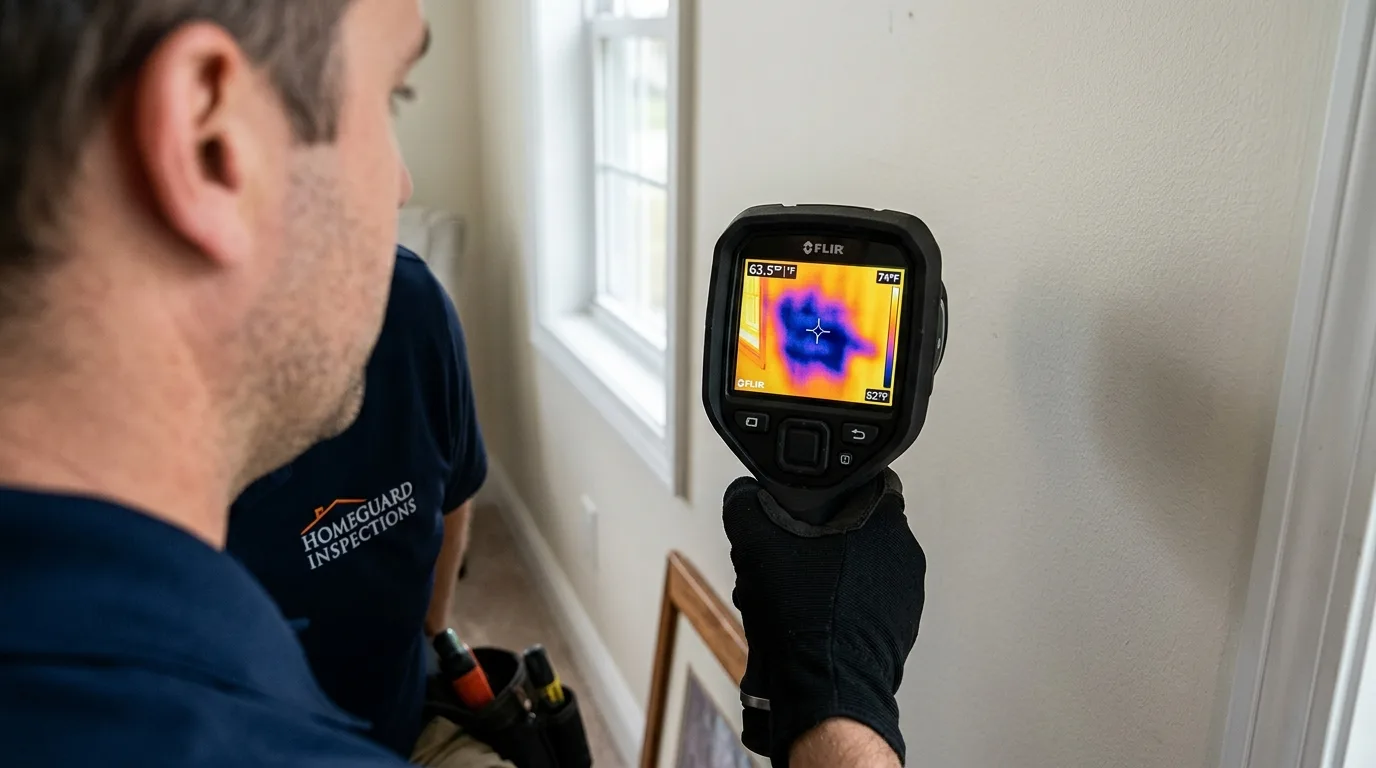
- Call for moisture assessment — thermal imaging and moisture meters are the only reliable way to map the extent of hidden water damage without demolition.
- Call your insurance carrier — especially if the water source was a sudden event (burst pipe, appliance failure) rather than long-term seepage.
Frequently Asked Questions
Can I ignore a small water stain on my Riverton basement wall?
A stain that is not actively wet or growing can be monitored briefly, but should be investigated — not ignored. Even an old, dry stain indicates that water entered at that location before and will likely enter again during the next spring snowmelt season or heavy rainfall. A professional moisture assessment can determine whether hidden damage from the prior event is still present and whether structural repairs are needed to prevent recurrence.
How do I know if I have mold behind my walls in Riverton?
Musty odor is the most reliable indicator of hidden mold in wall cavities. Air sampling, which measures airborne spore concentrations, can confirm mold presence even without visible growth. If you’ve had any water intrusion in the past six months — especially during Riverton’s spring snowmelt season — a professional mold inspection is warranted. Read our full guide on mold after water damage in Riverton for more detail on what to look for and when to act.
Do I need a professional to find hidden water damage, or can I do it myself?
Consumer moisture meters are available but provide surface readings only — they cannot measure moisture inside wall assemblies or under concrete slabs where hidden water damage most often accumulates. Professional thermal imaging cameras detect temperature differentials caused by moisture evaporation inside walls, which surface tools cannot access. For hidden water damage detection in Riverton, professional assessment is the only reliable approach.
Don't Wait Until Water Damage Becomes a Major Repair
Riverton Water Damage Restoration uses thermal imaging and professional moisture meters to find hidden damage early. Call (877) 698-1311 for a free assessment.
Related: